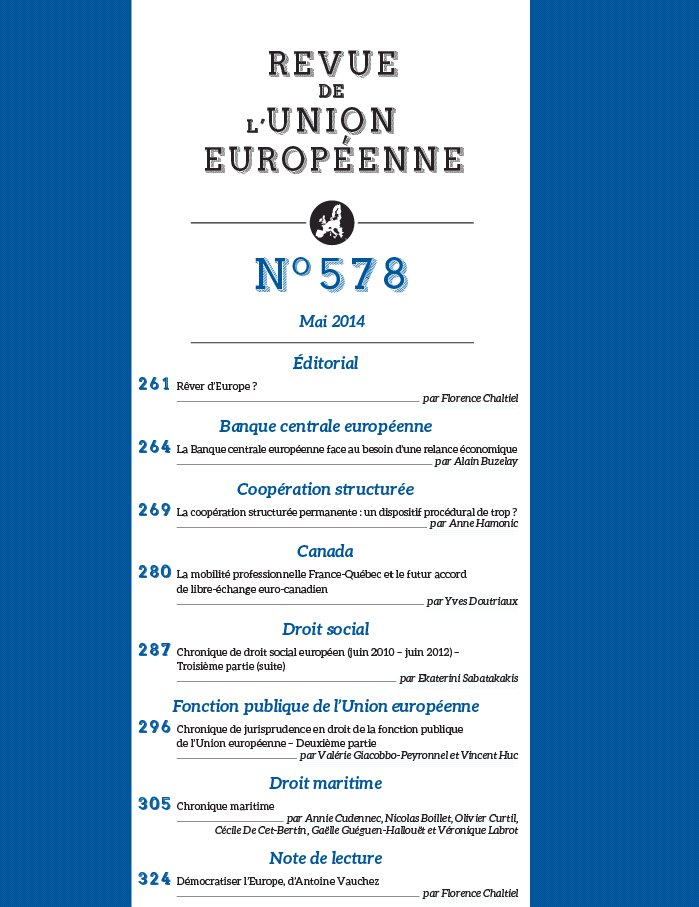
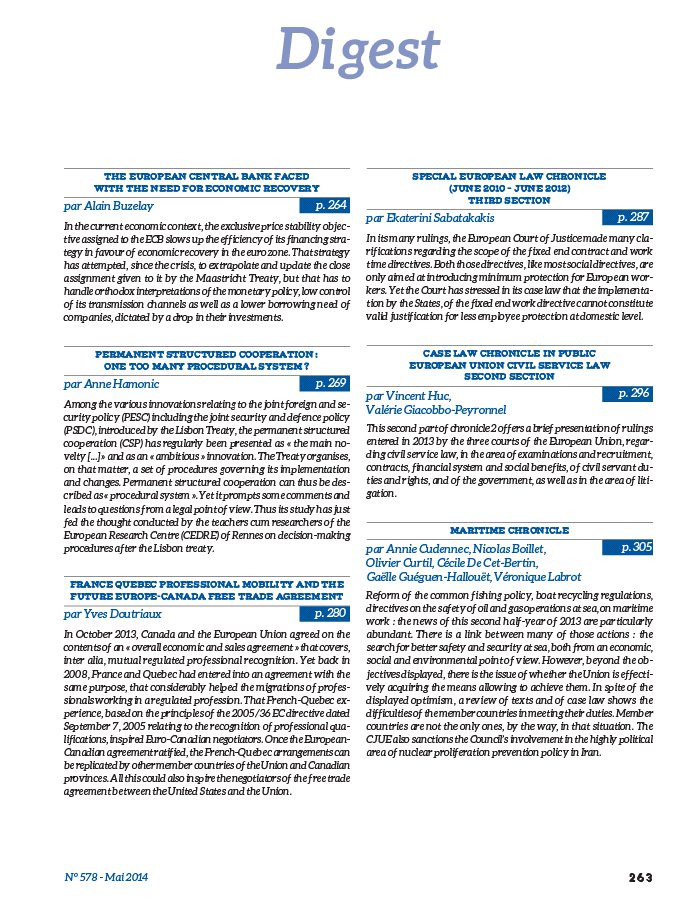
Éditorial 261 Rêver d’Europe ? par Florence Chaltiel Banque centrale européenne 264 La Banque centrale européenne face au besoin d’une relance économique par Alain Buzelay Coopération structurée 269 La coopération structurée permanente : un dispositif procédural de trop ? par Anne Hamonic Canada 280 La mobilité professionnelle France- Québec et le futur accord de libre- échange euro- canadien par Yves Doutriaux Droit social 287 Chronique de droit social européen ( juin 2010 – juin 2012) – Troisième partie ( suite) par Ekaterini Sabatakakis Fonction publique de l’Union européenne 296 Chronique de jurisprudence en droit de la fonction publique de l’Union européenne – Deuxième partie par Valérie Giacobbo- Peyronnel et Vincent Huc Droit maritime 305 Chronique maritime par Annie Cudennec, Nicolas Boillet, Olivier Curtil, Cécile De Cet- Bertin, Gaëlle Guéguen- Hallouët et Véronique Labrot Note de lecture 324 Démocratiser l’Europe, d’Antoine Vauchez par Florence Chaltiel THE EUROPEAN CENTRAL BANK FACED WITH THE NEED FOR ECONOMIC RECOVERY par Alain Buzelay p. 264 In the current economic context, the exclusive price stability objec-tive assigned to the ECB slows up the efficiency of its financing stra-tegy in favour of economic recovery in the euro zone. That strategy has attempted, since the crisis, to extrapolate and update the close assignment given to it by the Maastricht Treaty, but that has to handle orthodox interpretations of the monetary policy, low control of its transmission channels as well as a lower borrowing need of companies, dictated by a drop in their investments. PERMANENT STRUCTURED COOPERATION : ONE TOO MANY PROCEDURAL SYSTEM ? par Anne Hamonic p. 269 Among the various innovations relating to the joint foreign and se-curity policy ( PESC) including the joint security and defence policy ( PSDC), introduced by the Lisbon Treaty, the permanent structured cooperation ( CSP) has regularly been presented as « the main no-velty [.] » and as an « ambitious » innovation. The Treaty organises, on that matter, a set of procedures governing its implementation and changes. Permanent structured cooperation can thus be des-cribed as « procedural system » . Yet it prompts some comments and leads to questions from a legal point of view. Thus its study has just fed the thought conducted by the teachers cum researchers of the European Research Centre ( CEDRE) of Rennes on decision- making procedures after the Lisbon treaty. FRANCE QUEBEC PROFESSIONAL MOBILITY AND THE FUTURE EUROPE- CANADA FREE TRADE AGREEMENT par Yves Doutriaux p. 280 In October 2013, Canada and the European Union agreed on the contents of an « overall economic and sales agreement » that covers, inter alia, mutual regulated professional recognition. Yet back in 2008, France and Quebec had entered into an agreement with the same purpose, that considerably helped the migrations of profes-sionals working in a regulated profession. That French- Quebec ex-perience, based on the principles of the 2005/ 36 EC directive dated September 7, 2005 relating to the recognition of professional qua-lifications, inspired Euro- Canadian negotiators. Once the European- Canadian agreement ratified, the French- Quebec arrangements can be replicated by other member countries of the Union and Canadian provinces. All this could also inspire the negotiators of the free trade agreement between the United States and the Union. SPECIAL EUROPEAN LAW CHRONICLE ( JUNE 2010 – JUNE 2012) THIRD SECTION par Ekaterini Sabatakakis p. 287 In its many rulings, the European Court of Justice made many cla-rifications regarding the scope of the fixed end contract and work time directives. Both those directives, like most social directives, are only aimed at introducing minimum protection for European wor-kers. Yet the Court has stressed in its case law that the implementa-tion by the States, of the fixed end work directive cannot constitute valid justification for less employee protection at domestic level. CASE LAW CHRONICLE IN PUBLIC EUROPEAN UNION CIVIL SERVICE LAW SECOND SECTION p. 296 This second part of chronicle 2 offers a brief presentation of rulings entered in 2013 by the three courts of the European Union, regar-ding civil service law, in the area of examinations and recruitment, contracts, financial system and social benefits, of civil servant du-ties and rights, and of the government, as well as in the area of liti-gation. MARITIME CHRONICLE p. 305 Reform of the common fishing policy, boat recycling regulations, directives on the safety of oil and gas operations at sea, on maritime work : the news of this second half- year of 2013 are particularly abundant. There is a link between many of those actions : the search for better safety and security at sea, both from an economic, social and environmental point of view. However, beyond the ob-jectives displayed, there is the issue of whether the Union is effecti-vely acquiring the means allowing to achieve them. In spite of the displayed optimism, a review of texts and of case law shows the difficulties of the member countries in meeting their duties. Member countries are not the only ones, by the way, in that situation. The CJUE also sanctions the Council’s involvement in the highly political area of nuclear proliferation prevention policy in Iran. par Vincent Huc, Valérie Giacobbo- Peyronnel par Annie Cudennec, Nicolas Boillet, Olivier Curtil, Cécile De Cet- Bertin, Gaëlle Guéguen- Hallouët, Véronique Labrot